
Agentic AI relies on several core components that define its power and flexibility. These building blocks work together to provide consistency, autonomy, and adaptability.
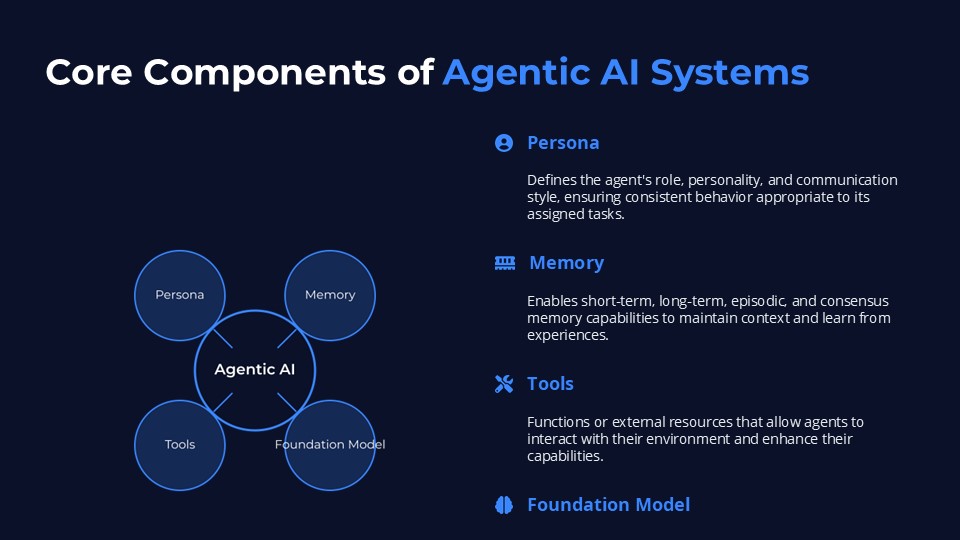
Each element plays a distinct role: personas shape interaction, memory retains context, tools connect systems, and foundation models supply intelligence. Combined, they create agents that can evolve, learn, and perform effectively in complex environments.
Persona and memory
The persona defines the agent’s role, tone, and behavior, ensuring communication remains consistent and trustworthy. Memory enables continuity by storing knowledge from both short-term and long-term experiences. This dual structure allows agents to recall past interactions, refine responses, and adapt to unique users. Together, persona and memory transform AI into systems capable of maintaining stable identities while evolving over time.
Tools and foundation models
Tools expand an agent’s reach by connecting it with external systems, from APIs to real-world devices. Foundation models provide the baseline intelligence, offering advanced language and reasoning abilities. By layering tools on top of models, agents gain practical utility and domain expertise. This modular approach enables scalability and versatility, allowing systems to function effectively across a wide variety of industries and use cases.
Next developments
Future progress will focus on refining each component for greater depth and adaptability. Memory will become richer and context-aware, personas more dynamic, and tools increasingly integrated with real-world infrastructure. Foundation models will broaden in scope, enabling domain-specific expertise alongside general intelligence. These advancements will push agentic AI from capable assistants to indispensable collaborators in professional and personal environments.